
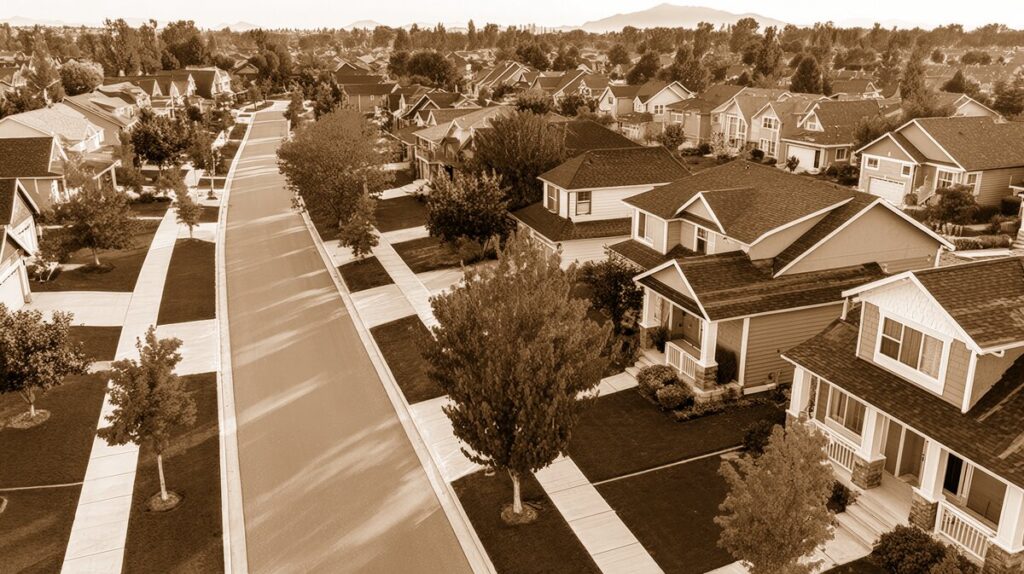
A Neighborhood with a Quiet Sense of Place
Oak Crest is one of those Arvada neighborhoods that can feel pleasantly familiar even to a first-time visitor. Its streets are primarily residential, its homes reflect several eras of suburban development, and its location places residents within easy reach of parks, schools, shopping, and the larger traditions of west Jefferson County.
Unlike Arvada’s Olde Town district, where historic storefronts and early civic buildings make the past immediately visible, Oak Crest’s heritage is found in smaller details: mature trees, long-established homes, familiar school routes, neighborhood parks, and the way older streets connect to newer parts of the city. It is a community shaped less by one dramatic landmark than by decades of everyday life.
Origins in a Growing Arvada
Oak Crest developed during the period when Arvada was changing from a farming community into a suburban city. Arvada’s earliest history reaches back to the mid-19th century, when settlers farmed along Ralston Creek and Clear Creek. The community was formally named in 1870, after Mary Ann Wadsworth suggested “Arvada” in honor of her brother-in-law, Hiram Arvada Haskin. Agriculture, railroads, and access to Denver helped the young town prosper. ([arvadaco.gov](https://www.arvadaco.gov/589/The-Founding-of-Our-Community?utm_source=openai))
By the middle of the 20th century, the fields and open tracts surrounding central Arvada were increasingly being divided into residential neighborhoods. New subdivisions offered families something different from the older town center: larger lots, quieter streets, attached garages, and modern homes with room for children to play.
Oak Crest belongs to that suburban generation. Its development reflects the postwar expansion that helped connect central Arvada with neighborhoods farther west, toward Kipling Street, Ward Road, and the foothills. The city’s postwar building boom included subdivisions such as Vetting, Allendale, and others created by local developers responding to demand from teachers, tradespeople, office workers, and young families. ([ntlrepository.blob.core.windows.net](https://ntlrepository.blob.core.windows.net/lib/41000/41300/41309/DenverWWIISuburbs.pdf?utm_source=openai))
How Oak Crest Got Its Name
The name Oak Crest appears to be a neighborhood-development name rather than one tied to a single historic person or event. In Arvada, subdivision names often described the landscape, suggested elevation or views, or conveyed an appealing image of residential life. “Oak Crest” combines two familiar ideas: the strength and shade associated with oak trees and the sense of a gently raised or desirable residential setting.
That name also fits the broader character of the area. Mature trees now soften many of Oak Crest’s streets, giving portions of the neighborhood a settled, established appearance. Like nearby communities with names such as Club Crest, Wood Run, and Woodland Valley, Oak Crest reflects the language of mid-century suburban planning—names intended to distinguish new residential enclaves while evoking nature and permanence.
Because subdivisions were often marketed through plats, builder advertisements, and real-estate materials rather than grand civic ceremonies, their early stories can be less visible than Arvada’s pioneer history. In Oak Crest, the name survives most clearly through street signs, property records, neighborhood references, and the identity residents have carried forward.
Streets, Schools, and Everyday Landmarks
Oak Crest is best understood through the streets and institutions that anchor daily life. West 72nd Avenue and West 74th Avenue provide major connections through this part of Arvada, while Oak Street and nearby residential roads help give the area its local identity. Depending on the boundary being used, real-estate sources also distinguish Oak Crest South from other nearby sections of the neighborhood.
Schools have been especially important to Oak Crest’s heritage. Oberon Junior High School, located near West 74th Place, has served as a familiar landmark for generations of local families. Arvada West High School, a major educational institution in the western part of the city, also represents the community’s growth from a small agricultural town into a substantial suburban municipality.
Parks and recreation add another layer to the neighborhood’s story. Nearby Faversham Park and Arvada Volunteer Firefighters Park provide ball fields, playgrounds, open grass, and gathering places. The city’s park system also connects neighborhoods through trails along waterways such as Ralston Creek and the Big Dry Creek corridor. Arvada Volunteer Firefighters Park, at West 84th Avenue, includes ball fields, basketball, a playground, picnic areas, and the Rainbow Trail. ([arvadaco.gov](https://www.arvadaco.gov/1039/Park-Inventory-and-Amenities?utm_source=openai))
For many residents, these places are more meaningful than formal monuments. A school drop-off lane, a Little League field, or a park picnic shelter can become part of a family’s personal history.
From Small Subdivision to Established Community
Oak Crest has evolved in much the same way as Arvada itself. Early residents likely encountered more open land, fewer commercial services, and a stronger separation between subdivisions. Over time, new roads, shopping centers, schools, churches, and public facilities filled in the spaces between older neighborhoods.
Homes that once represented the latest in postwar design have gradually become part of Arvada’s architectural heritage. Ranch houses, split-levels, brick-front homes, and two-story suburban designs tell the story of changing preferences and family life. Some properties have been remodeled with updated kitchens, additions, solar panels, or new landscaping, while others retain much of their original appearance.
This gradual evolution is part of Oak Crest’s appeal. The neighborhood is not frozen in one decade. Instead, it shows how a community adapts while retaining familiar patterns: children walking to school, neighbors greeting one another on evening walks, and families returning to the same parks year after year.
Oak Crest and the Larger Arvada Story
Oak Crest’s heritage is closely tied to Arvada’s broader history of transportation and expansion. The Colorado Central Railroad helped establish Arvada’s early connection to Denver and Golden, while later roads and automobiles made westward suburban development possible. The city’s historic districts, including Olde Town, Reno Park, and the Stocke-Walter Addition, preserve earlier chapters of that story. The Stocke-Walter district, for example, contains homes dating from the late 19th century through the 1940s and reflects Arvada’s transition from agricultural settlement to established town. ([arvadaco.gov](https://www.arvadaco.gov/425/Historic-Neighborhoods?utm_source=openai))
Oak Crest represents a later chapter: the era when Arvada became a place where Denver-area families could find a suburban home without giving up access to employment, schools, and the mountains. Its history is therefore not separate from Arvada’s pioneer past; it is the continuation of it.
What Makes Oak Crest Special Today
What makes Oak Crest special is its balance of familiarity and change. It has the comfort of an established neighborhood, yet it remains connected to the larger energy of modern Arvada. Residents can reach Olde Town, regional trails, recreation facilities, shopping areas, and major roads without losing the quieter atmosphere of home.
The neighborhood’s heritage lives in its mature landscaping, its long-standing schools, its parks, and the memories held by residents who have watched Arvada change around them. Oak Crest may not always appear in the spotlight, but that is part of its charm. It is a place where history is woven into ordinary routines—and where the story of Arvada continues one street, one family, and one season at a time.